

Apple Acquires Key Talent & Patents Behind AI Avatar Company ‘Animato’

Possibly improving Vision Pro's Personas

4

According to an official EU filing spotted by Apple Insider, Apple has recently acquired key talent and IP behind Animato, a Bay Area startup creating AI avatars.

Animato was known for the now-defunct AI video calling app Call Annie, which paired 3D avatars with AI for face-to-face tutoring and language learning.

According to the filing (seen below), Apple isn’t outright acquiring Animato, but rather reserving the right to hire certain employees, get non-exclusive licenses to Animato’s intellectual property rights, and acquire Animato’s patent applications.

Here’s the January 19th filing via the European Commission’s Digital Markets Act:

Apple Inc. (“Apple”) will have the right to make employment offers to and hire certain employees of Animato, Inc. (“Animato”), receive a non-exclusive license to Animato’s intellectual property rights, and acquire Animato’s patent applications. Animato develops and distributes software that creates virtual avatars for video chats and tutoring. Apple (together with its group companies) designs, manufactures and markets smartphones, personal computers, tablets, wearables and accessories, and sells a variety of related services.

According to LinkedIn, Animato was founded by Francesco Rossi, who worked at Apple from 2015-2022 in the company’s computer vision R&D department, which included work on machine learning.

Having left Apple in 2022 to found Animato, the company released two now-defunct apps, Call Annie and BeSanta, the latter of which let users create impersonate Santa Claus and record videos for playback.
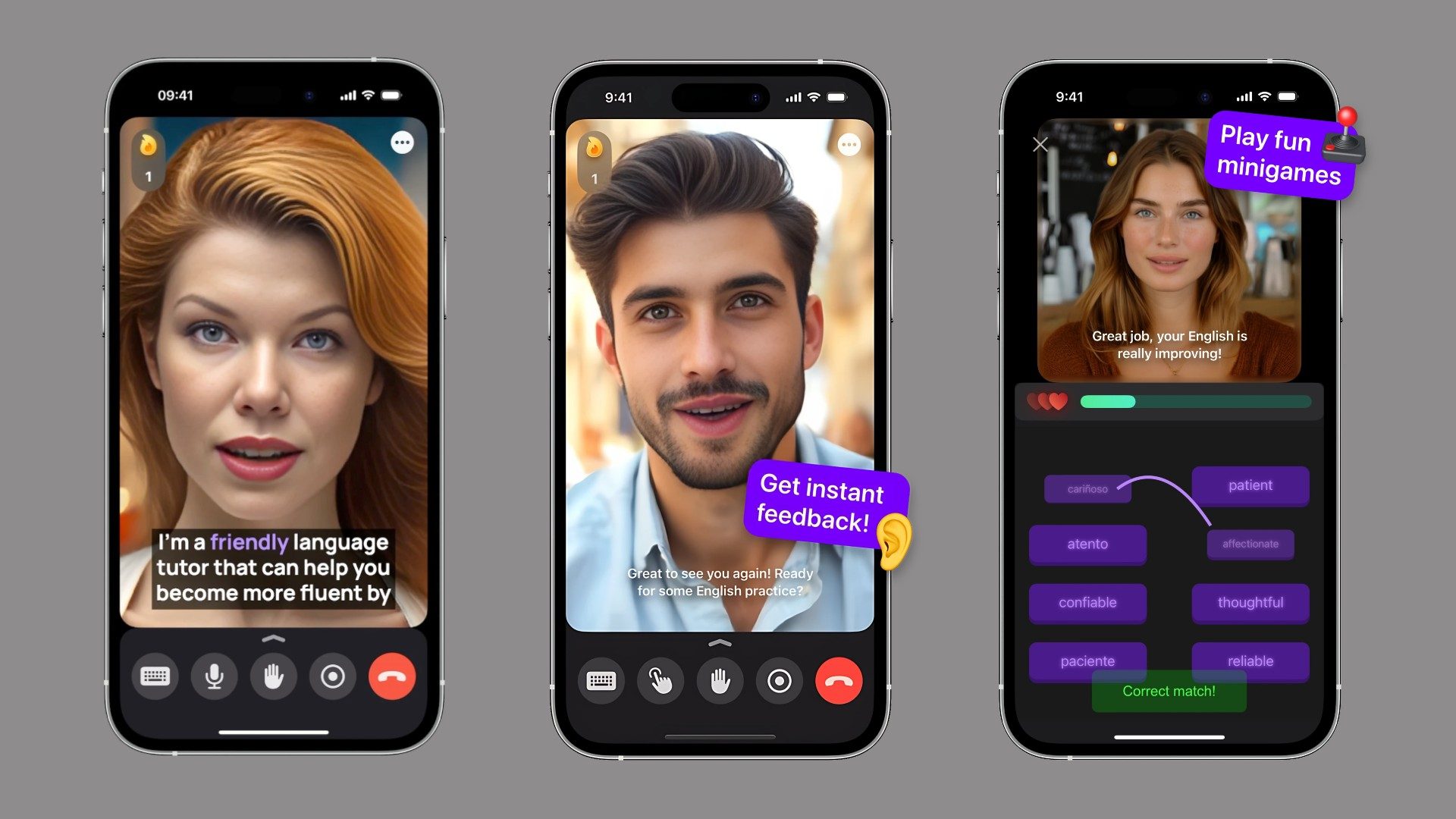
‘Call Annie’ | Images courtesy Animato Inc

This isn’t the first avatar-related acquisition (or in Animato’s case acqui-hire) Apple has undertaken following the 2024 launch of Vision Pro.

In early 2025, Apple quietly acquired 3D avatar company TrueMeeting, having obtained its 3D avatar tech stack and a number of its employees. At the time, the deal was thought to support the company’s photorealistic avatars for Vision Pro, aka ‘Personas’.

SEE ALSO
'Teenage Mutant Ninja Turtles' VR Game is Getting a Steam Demo Ahead of Spring Launch

Notably, Personas are some of the most realistic 3D avatars in the XR space right now. Based on facial scans, Personas are animated with the help of Vision Pro’s various sensors; the downward-facing camera tracks mouth movement, internal sensors track your eyes and facial micro-expressions, and a particularly advanced machine learning stack blends all of this together into a realistic 3D avatar.

At least in terms of what we’ve seen in Call Annie, Animato’s tech seems to be more targeted at creating realistic AI avatars, which is something Apple may be after as the company further develops not only XR headsets like Vision Pro, but its forthcoming AR glasses, which are rumored to follow its first smart glasses—still in development behind closed doors.


This article may contain affiliate links. If you click an affiliate link and buy a product we may receive a small commission which helps support the publication. See here for more information.

Well before the first modern XR products hit the market, Scott recognized the potential of the technology and set out to understand and document its growth. He has been professionally reporting on the space for nearly a decade as Editor at Road to VR, authoring more than 4,000 articles on the topic. Scott brings that seasoned insight to his reporting from major industry events across the globe.
  • Christian Schildwaechter

    TL;DR: any Apple investment into XR consumer content and tech is a good sign for the market and future HMD development.

    With the launch of the Steam Frame (hopefully) looming, I've been thinking about what I'd like from a new HMD. And while I REALLY like the flexibility that SteamOS would provide, and have a lot of faith in Valve's engineers to deliver a light and capable headset that will be great for gaming, my personal interests are more about non-gaming use cases.

    For this the worst aspect of Frame is the lack of hand tracking, followed by still rather lowres b/w passthrough, probably without geometry correction, and finally the 2K resolution. Looking at my intended use, what I really want is an Apple Vision Air at half the weight of AVP, properly balanced with the new weighted dual knit band, stuffed with sensors and hires displays, designed for anything but gaming.

    So I really welcome that Apple keeps investing into more tech and content that only make sense with XR HMDs, despite now also going for much simpler, display-less smartglasses, Tim Cook as the CEO that pushed AVP stepping down in a few months, and AVP only selling in homeopathic doses and now mostly targeting the enterprise market. Apple buying into avatar tech hints that they still aim to bring HMDs to the iPhone masses, meaning I will probably get the Apple Vision Air I am hoping for, though not anytime soon. But hey, I've been interested in VR since the early 90s, so I'm used to waiting for the tech to finally get ready.

    • Dragon Marble

      For non-gaming use cases the 2K LCD is not going to cut it. You don't want to miss your TV while in the headset.

      For gaming, you have the likes of Galaxy XR for high end and Quest 3 for both low and mid end. Quest 3 covers such a wide range of use cases that it leaves almost no room for Steam Frame. Now with the delay and potential price hike, I am even more bearish on the Valve's new headset.

      • Christian Schildwaechter

        TL;DR: The RAM price hikes make everything hard to predict, and nobody knows how much Meta's unsubsidized Phoenix/Quest 4 will go for, so we'll have to wait and see what the market accepts.

        I started programming on a computer with a 40 characters/320 pixel wide display, and still spend a lot of time logged into remote machines using 80*25 terminal windows, so resolution is a minor issue for me. 2160p is just a little inconvenient for large amounts of text or small structures, but I could easily make it work, esp. if SteamOS allows me to place applications wherever I like, similar to how visionOS allows to freely position iPad apps.

        In theory a Quest 3 would do fine for what I'm looking for, and I tried. Unfortunately for me it is too uncomfortable to wear for extended use, and extremely limited regarding window placement. While its hand tracking is decent, I have to disable it when using the HMD as a virtual screen because it permanently misinterprets me typing on a keyboard as gestures and then very annoyingly moves the windows around. And having to switch between mouse and keyboard for virtual screen use and a 6DoF controller for any other interface interaction is extremely cumbersome.

        What still may drive me to get a Frame is the flexibility to run and configure anything, so I can find a way to make it work. Lacking comfort has mostly stopped me from watching movies in HMDs, so not properly showing a 1080p image isn't a loss so far. A major motivation to get a Frame would be that I freakin LOVE my 1280*800 Steam Deck, I'd only like the screen to be physically larger. So Frame working as a Steam Deck with a 100" virtual display in addition to its use as a productivity standalone HMD and low latency PCVR streaming device is quite tempting, esp. since it may be years before Apple releases a Vision Air.

        Due to my specific requirements, my interest in the GXR or other Android XR HMDs is basically zero, esp. since they seem to be mostly testing platforms for Gemini AI use on future smartglasses. I am overall way more bullish regarding Frame than Android XR, esp. because I believe in the virtual display for flat gaming use that Valve emphasizes, even though most VR enthusiasts dismiss this idea. The price will be very important for its success, and it will probably sell a lot less than the Steam Deck, currently at about 8M units, and only a fraction of the 20M+ Quest 2. But like with the Index, Valve isn't aiming for either the highest specs nor the largest user share, but the best overall (gaming) experience.

        • VR Slut

          "mostly testing platforms" is too polite a way of saying what's really going on! They also get free publicity from VR news sites like this.