
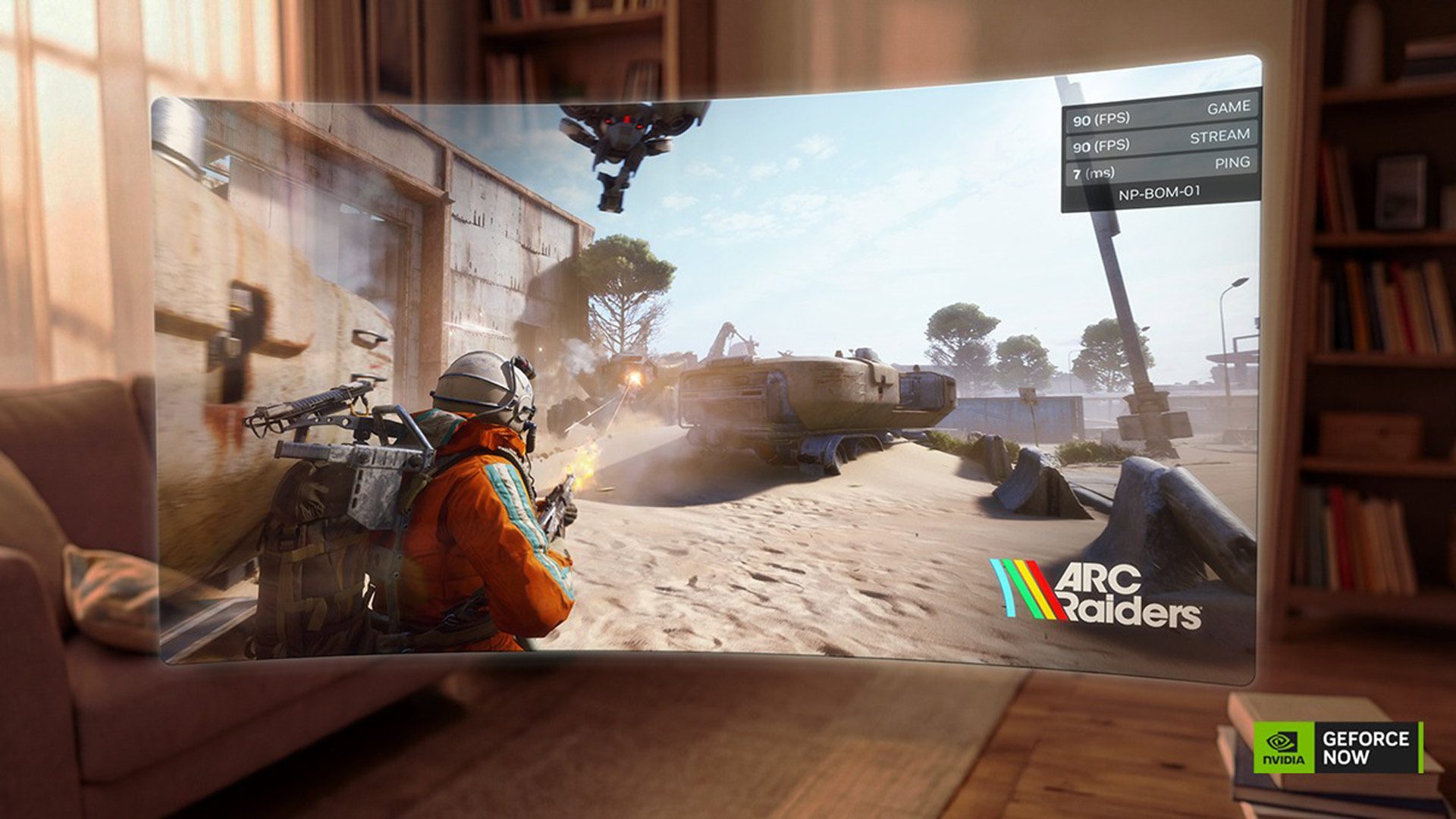
NVIDIA’s Cloud Gaming Now Supports up to 90 FPS on Quest, Vision Pro & Pico Headsets

6

Nvidia announced back at GDC earlier this month that it was upping framerate on its GeForce NOW cloud gaming service for VR headset streaming. Now the company has pushed the official update, which supports a host of popular standalone XR headsets.

The update brings “up to 90 fps” to the cloud gaming service to all supported VR platforms, which includes Vision Pro, Meta Quest, and Pico headsets.

Notably, the ‘up to 90 fps’ feature comes to Ultimate members, a premium subscription priced at $20 per month, or $200 per year—something Nvidia says offers RTX 50-series performance.

SEE ALSO
Godot Gets Big OpenXR Update Aiming to Attract XR Devs from Unity

One real caveat though if you’re hoping to play everything on a standalone headset: GeForce Now doesn’t yet include VR cloud gaming—i.e. the ability to play play VR-native titles—but rather access to standard games playable across Windows, Mac, Android, iOS, and handheld gaming devices.

Vision Pro users appear to get the best experience among VR headsets, thanks to built-in eye-tracking that enables Nvidia to deliver foveated PC streaming at up to 4K and 120 fps. This is the result of Nvidia partnering with Apple to bring its CloudXR platform to visionOS.

This article may contain affiliate links. If you click an affiliate link and buy a product we may receive a small commission which helps support the publication. See here for more information.

Well before the first modern XR products hit the market, Scott recognized the potential of the technology and set out to understand and document its growth. He has been professionally reporting on the space for nearly a decade as Editor at Road to VR, authoring more than 4,000 articles on the topic. Scott brings that seasoned insight to his reporting from major industry events across the globe.
  • timo weber

    I m waiting for christian schildwaechter to tell us when NVIDIA will allow vr games to be played and what the problem is why this has not been done yet when I used shadow pc perfectly fine to stream be games in 2020

    • Christian Schildwaechter

      TL;DR: the problem is Meta, not Nvidia

      Quest VR Cloud streaming:
      www_roadtovr_com/azure-remote-rendering-meta-quest-2-pro/#comment-6217414291

      Nvidia CloudXR, mostly about foveated streaming:
      www_roadtovr_com/visionos-update-improved-vr-cloud-streaming-tools/#comment-6839087955

      Short(er) version: once Meta no longer prohibits cloud VR streaming in the Quest EULA, keeping clients out of the Horizon store this way. Which so far has limited VR cloud streaming to either DIY solutions with VRD/ALXR connecting to a remotely accessible (Shadow) PC, or required sideloading the client, like with PlutoSphere. And Meta probably won't allow it before their own Avalanche PCVR cloud streaming service has launched, which now may never happen.

      Unfortunately not a lot has changed in the three years since I wrote the first of the above comments about Quest VR cloud streaming. The now updated Geforce client is possible because Meta only restricts VR cloud streaming, they never had a issue with any flat game cloud streaming. The problem was never a technical, only a legal one, with Meta's license keeping away potential competitors for VR game revenue. And it works similarly to how they initially prohibited wireless VR streaming with VRD even from a local PC until they had released their own AirLink solution.

      • Andrew Jakobs

        But that doesn't explain why it isn't available on AVP or Pico headsets.

        • Christian Schildwaechter

          TL;DR: too few users

          That's probably because Pico's VR market share is tiny, and Apple's VR marketshare is negligible, as users not only have to pay USD 3500 for AVP, but then also USD 300 for a pair of PSVR2 Sense controllers to even be able to play PCVR games via streaming. Given the overall small number of people using game streaming, the much smaller number of VR users interested due to latency concerns, I doubt that Nvidia would consider developing an XR variant of Geforce Now just for these niche in a niche in a niche user groups.

          And technically there are clients for Nvidia's CloudXR service for both AVP and Pico. AVP got a native client, Pico only a WebXR client that would also work with the Meta Quest browser. CloudXR is just an OpenXR runtime with extensions for streaming, so you could easily use it to stream a Steam VR game to pretty much any HMD. What's lacking is the easy to use Geforce Now client that connects to existing Steam, Epic, GOG, Ubisoft etc. accounts and skips the need to first install a game before playing by keeping thousands of popular titles pre-installed, just adding users specific game saves and settings upon launch. Which Nvidia will currently not offer for XR HMDs due to the involved cost/reasons mentioned above.

          It's a valid question whether Nvidia would have released a Quest version of Geforce Now for playing VR games years ago if Meta would have allowed it, which then might also have been ported to Pico and later AVP. My guess is yes, as they have been investing a lot into their CloudXR infrastructure without any good show cases, and PCVR streaming as part of Geforce Now would have been a great example. The CloudXR runtime already supports both foveated rendering and foveated streaming, which would help a lot with reducing latency with long streaming distances, and probably runs from the same data centers.

          Around 2020/2021, with the pandemic keeping people indoors and the Quest 2 seeing peak success, adding XR support to Geforce Now would probably have been seen as a good business opportunity with lots of growth potential. I'm not sure if Nvidia would still do it today, even if Meta would finally allow cloud VR streaming on Quest, simply because the future of VR currently looks rather bleak. We may have to wait for Frame hopefully providing a push for PCVR streaming, or Apple releasing a Vision Air at much lower price and weight and selling in much larger numbers for XR HMDs to become interesting again for large cloud streaming services.

          • Andrew Jakobs

            ah, thanx, didn't know about the CloudXR. It's a shame Geforce Now itself doesn't support CloudXR.
            I see Pico also has a native client (at least I see an OpenXR_CloudXR_Client_Demo on their github).

          • Christian Schildwaechter

            I didn't know Pico created their own CloudXR client, I was only aware of those provided by Nvidia, but CloudXR really is just OpenXR called remotely, so it should be pretty easy to attach any OpenXR capable HMD to it.

            Which nowadays is pretty much every HMD except AVP, which therefore got a dedicated CloudXR client that translates the proprietary Apple XR API to OpenXR, and thereby adds OpenXR compatibility even to AVP. And I still hope that either Geforce Now or CloudXR or Plutosphere or any other service will come up with an attractive VR streaming offer in the future, because this would allow for some very small/light HMDs still providing a high end PCVR experience at low cost.