
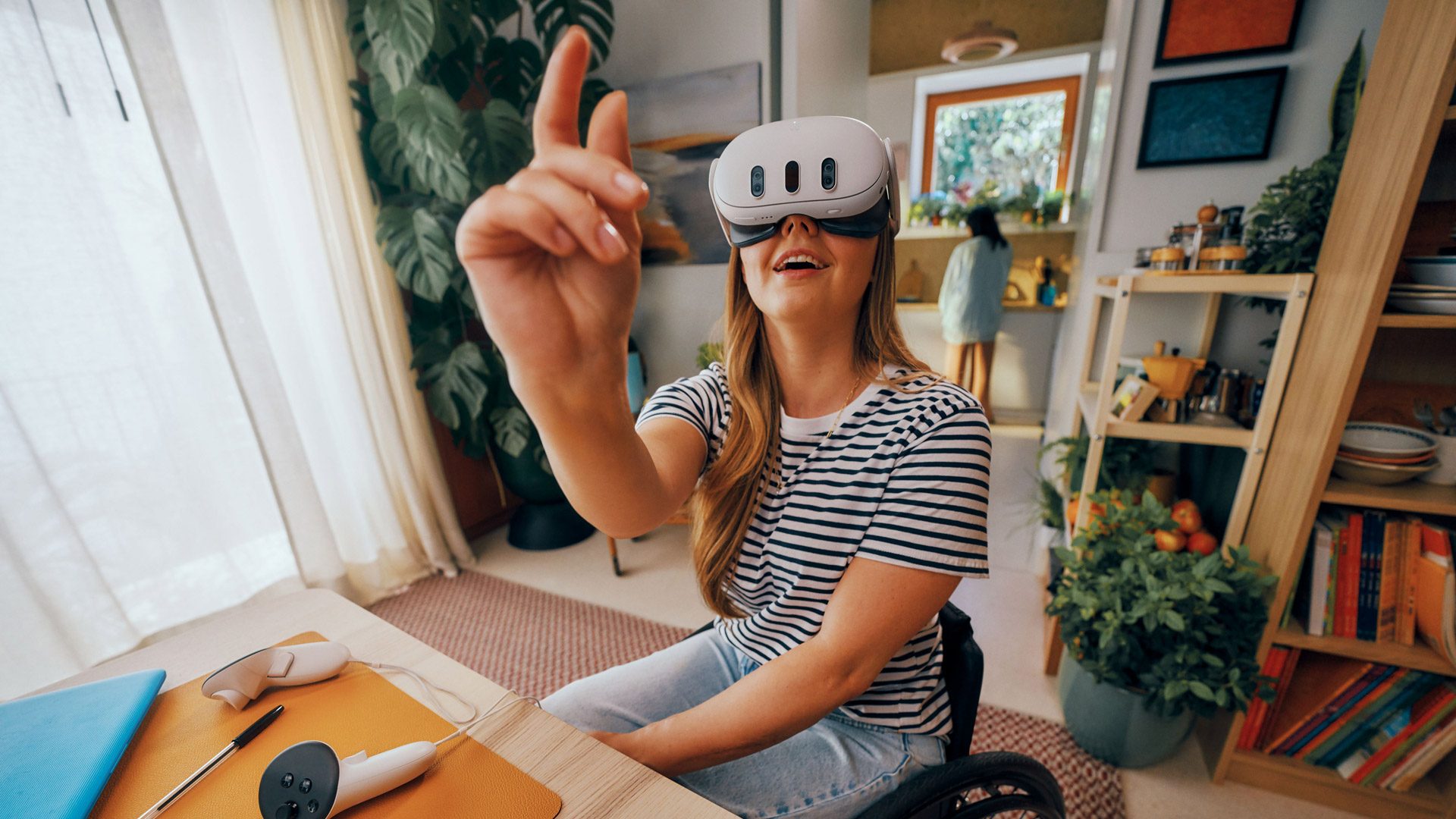
New Quest Update Brings Big Upgrades to Hand-tracking

10

Meta has rolled out a new update to Quest that aims to drastically improve hand-tracking performance and reliability.

The News

The v83 update, which is rolling out now to Horizon OS, is said to increase reliability of hand-tracking in a number of cases, including during fast movements, when used for locomotion, and throwing virtual objects.

In the so-called ‘Hands 2.4’ implementation, the update makes high-speed interactions feel “more responsive and believable,” Meta says in a recent developer blog post, noting that fast twitch movements have historically challenged hand-tracking, especially in rhythm and fitness apps.


The Interaction SDK also sees major enhancements, Meta says. New hand-first locomotion samples, such as improved teleportation gestures, natural climbing, and physics-based movement, are also included so developers can use them without having to build their own systems from scratch.

Notably, developers now have more customizable throwing interactions, also including new sample scenes demonstrating styles like darts, bowling, frisbee throws, and ball sports.

Developers looking for more information can check out the documentation for both the Unity and Unreal game engines.

SEE ALSO
Valve Expands 'Steam Link' PC VR Streaming to More Headsets and Opens the Door to Android XR

My Take

True to Meta’s word, v83 seems to be a big improvement to hand-tracking on Quest. I kind of wonder why it all matters though. To me, the supposition largely seems to be this: we know how to use our hands, so logically the most immersive way of interacting in VR should be the same. Right?

I honestly don’t think so, at least not for now. While I’d agree there is no perfect input scheme in VR (short of a direct neural link), controllers still offer the best input experience in a majority of cases.

Image courtesy Meta

Granted, I admire Meta for ratcheting down yet further on its optical hand-tracking tech, which is streets ahead of what we saw when the company rolled out hand-tracking on Quest in 2019. But even now in v83, it can only approximate some of the controller’s functionality.

Yes, I can pinch and grab, or hold my thumb and index finger to open a system menu, and also twiddle my virtual fingers about—the last of which promises a level of input granularity that not many XR games can really make use of. Maybe now I can punch a little more accurately, and teleport around a little more reliably. Still, I’d much rather just grab a controller and get the job done 100 percent of the time.

This article may contain affiliate links. If you click an affiliate link and buy a product we may receive a small commission which helps support the publication. See here for more information.

Well before the first modern XR products hit the market, Scott recognized the potential of the technology and set out to understand and document its growth. He has been professionally reporting on the space for nearly a decade as Editor at Road to VR, authoring more than 4,000 articles on the topic. Scott brings that seasoned insight to his reporting from major industry events across the globe.
  • Stephen Bard

    No matter how good hand-tracking gets, it remains a clever scientific novelty to me that I would never routinely use. No trigger feel or haptics!

    • Acurisur

      Clearly it's not aimed at you if don't use it. Controllers are absolutely useless in a lot of MR applications so that's why improvements to hand tracking are necessary.

  • Vaske

    This article is pretty streets ahead

    • ABC

      Ahead in the streets, behind in the sheets.

    • Kevin Files

      If you have to ask, you're streets behind.
      -Pierce Hawthorne

  • Brandon Gratta

    I think this is in line with rumors of their next headset being mixed reality focused with no controllers. Makes sense they're improving this aspect of it prior to so people trust the concept more.

    that being said, while I can see some fun use for it and do use it even now occasionally, until they figure out pairing that with haptic glove type feedback, I'll still prefer the controller. No feedback does hurt immersion more than holding a controller imo

  • EricTbone

    "the supposition largely seems to be this: we know how to use our hands, so logically the most immersive way of interacting in VR should be the same. Right?"

    Unfounded supposition. It's an alterative. If you want your hands free, you can. If you're watching a movie, you can be holding your popcorn bucket and still reach up to pause the movie.

    It's an important area of research, because it's going to crucial for AR. AR is going to be the mainstream tech. Once they can pack enough power into the right form factor at the right price, once it's good enough to replace your mobile phone screen, it will dominate, and good hand tracking will be huge for that.

  • Remember that fitness is still a popular use case for VR/MR. And doing fitness with bare hands is better than with controllers, so this update is welcome for many people in the Quest ecosystem

  • psuedonymous

    "I kind of wonder why it all matters though. To me, the supposition largely seems to be this: we know how to use our hands, so logically the most immersive way of interacting in VR should be the same. Right?

    I honestly don’t think so, at least not for now. While I’d agree there is no perfect input scheme in VR (short of a direct neural link), controllers still offer the best input experience in a majority of cases."

    So improving hand tracking doesn't matter, because Hand Tracking is not as good an experience as controllers? And how exactly do you think hand tracking will improve without… improving hand tracking?

    Controllers have certain use-cases where they are superior, specifically those where inputs with tactile or haptic feedback to input registration are necessary. If you treat a HMD as an 'FPS shooter box' or as a gaming-only device then controllers are necessary and hand tracking pointless, but for the majority of general interactions input-registration haptics are a nice-to-have rather than a necessity, and require interaction and UX compromises elsewhere (e.g. modality swaps between holding controllers and interacting with literally anything else using your hands).

  • eadVrim

    Next step towards a light mixed reality glasses (Quest 4).