‘ROG XREAL R1’ Pre-orders Now Live – 240Hz MicroOLED Gaming Glasses Priced at $850

15

ASUS Republic of Gamers (ROG) and XREAL today announced pre-orders for ROG XREAL R1, the microOLED gaming AR glasses that boast up to 240Hz refresh rate.

Unveiled at CES 2026 in January, ROG XREAL R1 are AR glasses that focus on playing traditional content, whether it be from tethered USB-C handhelds and mobile devices, or PCs and consoles via its external ‘ROG Control Dock’, which includes DisplayPort 1.4 and two HDMI 2.0 ports.

Now, ROG and Xreal announced they’re almost here, as the companies today released pre-orders in the US via Best Buy, priced at $850. Global pre-orders direct from Xreal are expected to go live on May 17th.
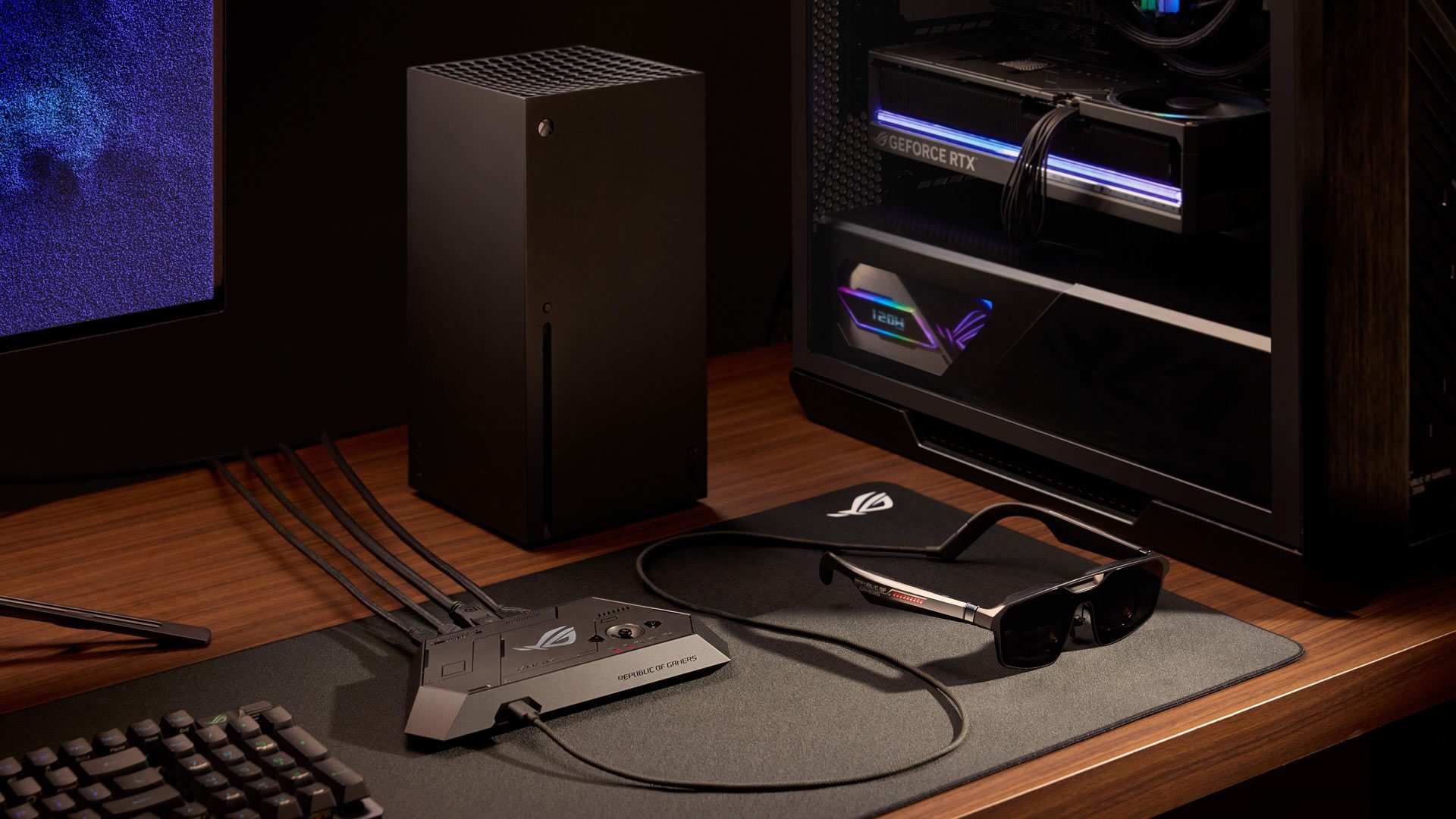
Image courtesy Asus ROG, XREAL

At the time of this writing, Best Buy orders are quoted at arriving on May 29th for both in-store pickup and courier shipping. ROG and Xreal say worldwide shipping is slated to begin on June 1st.

As for the device itself, ROG XREAL R1 serves up dual 1,920 x 1,080 microOLED panels clocked at 240Hz, which are displayed through birdbath optics boasting a 57 degree field-of-view (FOV).

SEE ALSO
'Teenage Mutant Ninja Turtles' VR Game is Getting a Steam Demo Ahead of Spring Launch

At a peak brightness of 700 nits and a 3ms motion-to-photon latency, the device is essentially now Xreal’s de facto flagship device, owing to its $850 price tag and its biggest leap in specs: a 240Hz refresh rate, double that of its previously released XREAL One Pro ($600). Notably, the ROG Control Dock comes in the box, and seems to be exclusive to ROG XREAL R1.

Like its little sibling One Pro though, ROG XREAL R1 offers 3DOF tracking, electrochromic tinting, and Sound by Bose audio. With the addition of the optional $100 XREAL EYE add-on, users can also unlock 6DOF tracking. Check out the main specs below for both the glasses and included ROG Control Dock:

ROG XREAL R1 Specs

Display
Sony 0.55-inch micro-OLED
Resolution 1,920 x 1,080
Refresh rate 240Hz
FOV 57°
Motion-to-photon latency 3ms
Peak brightness 700 nits
Color gamut 107% sRGB
3 Degrees of Freedom (DoF)
Native 3DoF, 6DoF supported
Adjustable lens transparency
3-level adjustable
Digital IPD adjustment Yes
Audio Sound by Bose
Weight 91g

ROG Control Dock Specs

I/O ports (Input)
2 x HDMI® 2.0
1 x DisplayPort™ 1.4
I/O port (Output) 1 x USB-C®
Video resolution 4K@60Hz
Dimensions
215 x 100 x 25mm
Weight 230g

This article may contain affiliate links. If you click an affiliate link and buy a product we may receive a small commission which helps support the publication. See here for more information.

Well before the first modern XR products hit the market, Scott recognized the potential of the technology and set out to understand and document its growth. He has been professionally reporting on the space for nearly a decade as Editor at Road to VR, authoring more than 4,000 articles on the topic. Scott brings that seasoned insight to his reporting from major industry events across the globe.
  • Rudl Za Vedno

    WTH would anyone buy XR glasses with 1,920 x 1,080 resolution and worse willingly pay $900 for it?

    I mean I find G2's 2,160 x 2,160p way too low to enjoy watching movies. 1,920 x 1,080 must look abysmal.

    • kraeuterbutter

      You don’t understand the concept of these glasses.

      I also have a G2, as well as an XReal One and a Viture XR Pro.

      The Reverb G2 has a PPD — pixels per degree — of around 24 PPD.
      The XReal One, with its 1920×1080 resolution, has around 44 PPD.

      In other words: the image feels higher-resolution and sharper in the XR glasses.

      The edge-to-edge clarity is also excellent, whereas the Fresnel lenses of the Reverb G2 offer very poor E2EC.

      Lastly, XR glasses use OLED displays — around 600 to 1000 nits to the eye, depending on the model — while the Reverb G2 uses LCD, with only around 150 to 200 nits max. to the eye (Quest3 around 120nits)

      These glasses are used for different things. The 50° FOV may sound small, but it is already more than what pretty much any film organization (imax, SMPTE (Society of Motion Picture and Television Engineers, THX, EDCF (European Digital cinema Forum), CEDIA, .. )recommends for a cinematic experience.

      Its also already good for working with Notebook, results in much bigger screen (better readable text) than a 15" notebook in front of you – AND: you can even have a 21:9 or 32:9 Screen infront of your (of course you need to turn your head than) – i often use the glasses for working with my notebook
      i have also a Quest3.. but: about 9 times more heavy and: also the resolution is pixelwise twice as big (~2000×2200) its less resolution per Degree, text is sharper and better readble in the xr-glasses

  • Rusty Shackleford

    IPD range? I wish the IPD range wasn't so commonly left out of the specs.

  • zaelu

    LOL

  • Foreign Devil

    Is it even stereoscopic?

    • kraeuterbutter

      yes, it is

  • bowman9991

    Please don't buy this! A wired device with 57 FOV, 1080p and 3DOF is barely usable for anything sensible. That is an incredible small field of view for AR (let alone VR). A high refresh rate won't fix your FOV and resolution issues. I've tried many of these style of glasses and they won't hit mainstream until someone cracks the FOV (and resolution issues). 90 FOV or more. Nothing else will do. Spend your money on a Quest 3 instead until something better comes along. Or the upcoming Steam Frame is gaming is your thing…

    • Lurch

      It's ana amazing device. I own the Xreal 1s which has slighty higher than 1080p screens. Amazing glasses.the AI 3D, epic. Xreal make some amazing glasses.

      • kraeuterbutter

        i have the xeral one.. love them too…
        you realy think the AI 3D is epic ?
        i like very part of the goggles, except of the AI 3D.. i think its overrated. i was disapointed because heard so much good about it, and when tested noticed its not at all comparable with a native 3D-Movie..many artefacts – still amazing that it is done within the X1 chip in the gogles !

    • kraeuterbutter

      i own meanwhile my second pair of such glasses.. first: Viture XR PRo (but no 3dof), now the xreal One –> great !
      i also have 11 VR-Headsets (started with vive)
      so: they are for different things.. i meanwhile use the xr-glasses more often..
      the FOV: coming from a VR-Headset (i also have a PImxe with over 160°FOV) its at first too small… but: after 2-3 days you get used to it.. its enough for watching movies (more than most movie-organisation are recommending for optimal FOV for watching movies) – and its also good for working, giving a bigger screen than Notebook.. but the killerfeature for me is using it with Steam Deck and Nintendo Switch… or with smartphone one the road…
      its so much better than playing with such small screens you have on a steamdeck or switch.. oh: i also have a Quest3.. and i have also – with HDMI-caputre card – used the quest3 as a "monitor" for switch and STeamdeck.. but: the colors are not as good with quest3 than with the xr-glasses (OLED), and the quest3 with good headstrap weights about 8-10times more than the xr-glasses.. so for many usecases the xr-glasses are better than the quest3… if you can only afford one thing: i would still get the quest3, because it can do everything and more

    • STL

      Obviously, there is a market for this.

    • Andrew Jakobs

      These are meant as videoscreen glasses, and for that they are probably decent enough. Personally I'm only interested in wireless VR headsets, not even mixed reality camerapassthrough for gaming.
      these glasses are meant for walking around, sitting in a bus/train/plane, a VR headset is not suitable for that, although some people still do that.

  • kraeuterbutter

    so what.. how would you make this wireless ?

    its not wireless.. but: it weights only around 75-80g…
    compared to for example Quest3 with 800-900g (using a headstrap that dont hurt)

    of course: wireless would be cooler if still would have enough runtime…
    not wireless, but for that very light, no problems with runtime and: never connection-problems or poor quality of image
    the wire is not a big problem.. its not like on VR where the wire is 6m long and tangeling between your legs..

    i have even used my xr-glasses for running 15km with the smartphone in my hand and the wire in my pullover, no problem.

    • STL

      I‘m spoiled from 800 hours of wireless PCVR with my Quest 3 via Wifi 6E. With a halo headstrap, I don’t feel it at all. Feels like a base cap!

  • silvaring

    Which of the main components going into these AR glasses are similar to the ones in newer docks or handhelds like the Steam Deck?

    Because if theres a cross pollination here, I can see these being a bundle type deal one day for all those gamers who are growing up in the Nintendo switch and DS era. This makes Nintendos long term approach all the more impressive if so.